Most designers guess at how finance actually works. I've lived inside it for 11+ years. Now, as a Senior Product Designer with 7+ years across fintech, B2B and AI, I turn operational complexity into clarity — from research and service blueprints to prototypes and design systems. End to end.
MD — FIG.01B'HAM, UK
Currently embedded at Goldman Sachs, leading design on a large-scale platform
transformation within a high-performing Loans engineering team. I'm particularly focused on
where AI meets financial workflows — designing intelligence into the systems
people rely on every day.
I work as a full-stack designer: research, service blueprints, wireframes,
prototyping, UX copy, and design systems. The rare part — I've sat on the finance side too,
so I read complex financial systems, not just design for them.
Zero-to-one transformation across mission-critical Corporate Loans products — workflow architecture, interaction design, and end-to-end UX at enterprise scale, with AI embedded natively into operational workflows.
Led the UX workstream migrating Barclays credit card journeys into the Tesco Bank app — reconciling two brands and two design systems on one foundation.
8+ journeys10+ usability sessions2 design systems
Product DesignDesign SystemsConsumer
Align cheque within frame✓ Captured
003BARCLAYS2024
Cheque Scanning SDK Integration
Integrated and optimised a third-party cheque-scanning SDK into the Barclays app, refining the camera capture flow to simplify a technically complex process for first-time users.
▲ 96% scan success▲ £800k/mo revenue
SDK IntegrationCamera Capture UXConsumer
How much do you need?£12,500
12mo24mo36mo
Continue →
004BARCLAYS2023
Loan Application Journey Redesign
Redesigned the personal loan entry point across app and online banking — clarity of UX copy, lower cognitive load, measurable conversion uplift.
▲ 15% in-app conversion▲ 13% online
UX CopyConversionConsumer
jaguarlandrover.com
RANGE ROVER
Build YoursTest Drive
005ACCENTURE / JLR2021 — 22
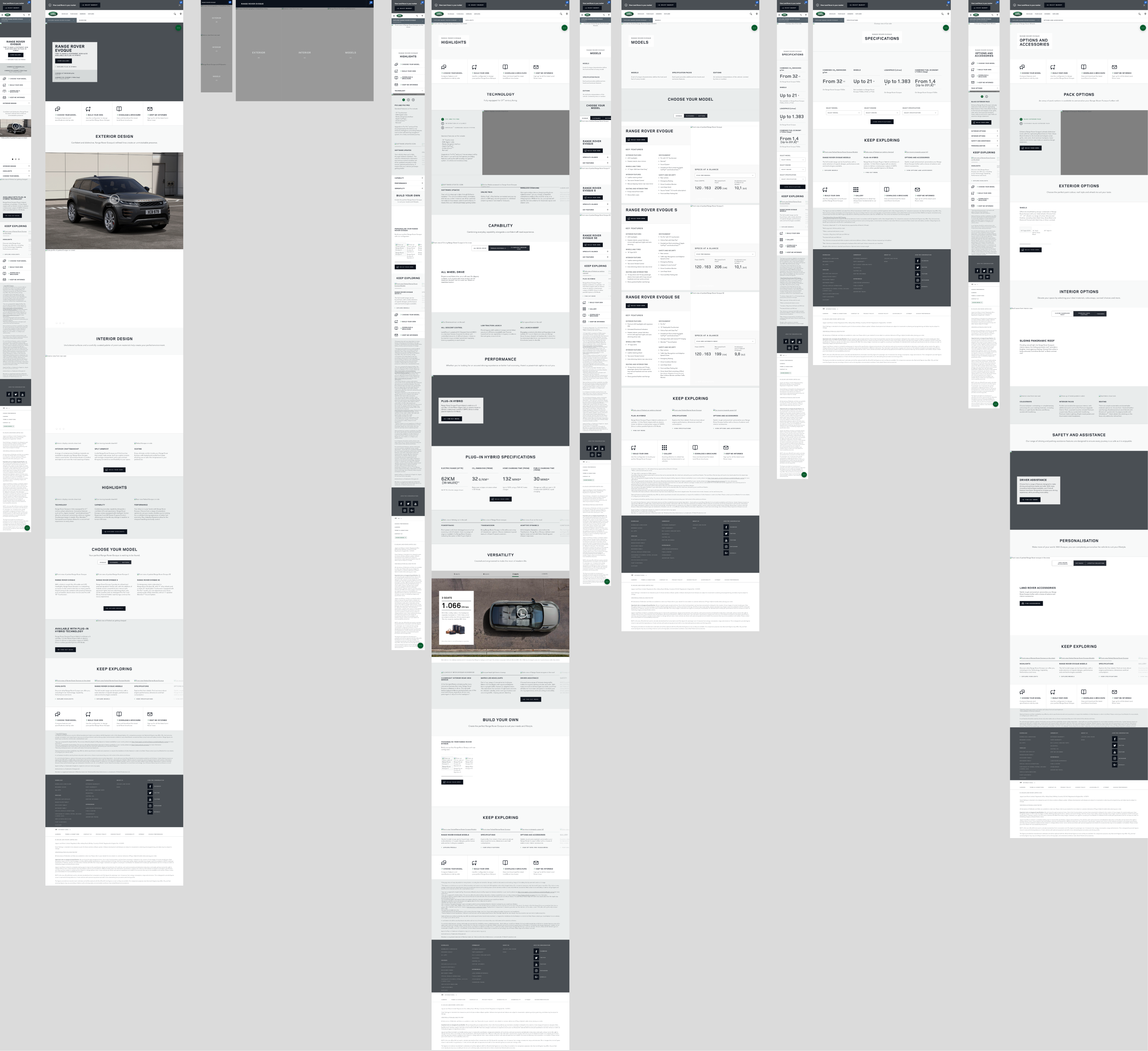
JLR Global Nameplate Pages
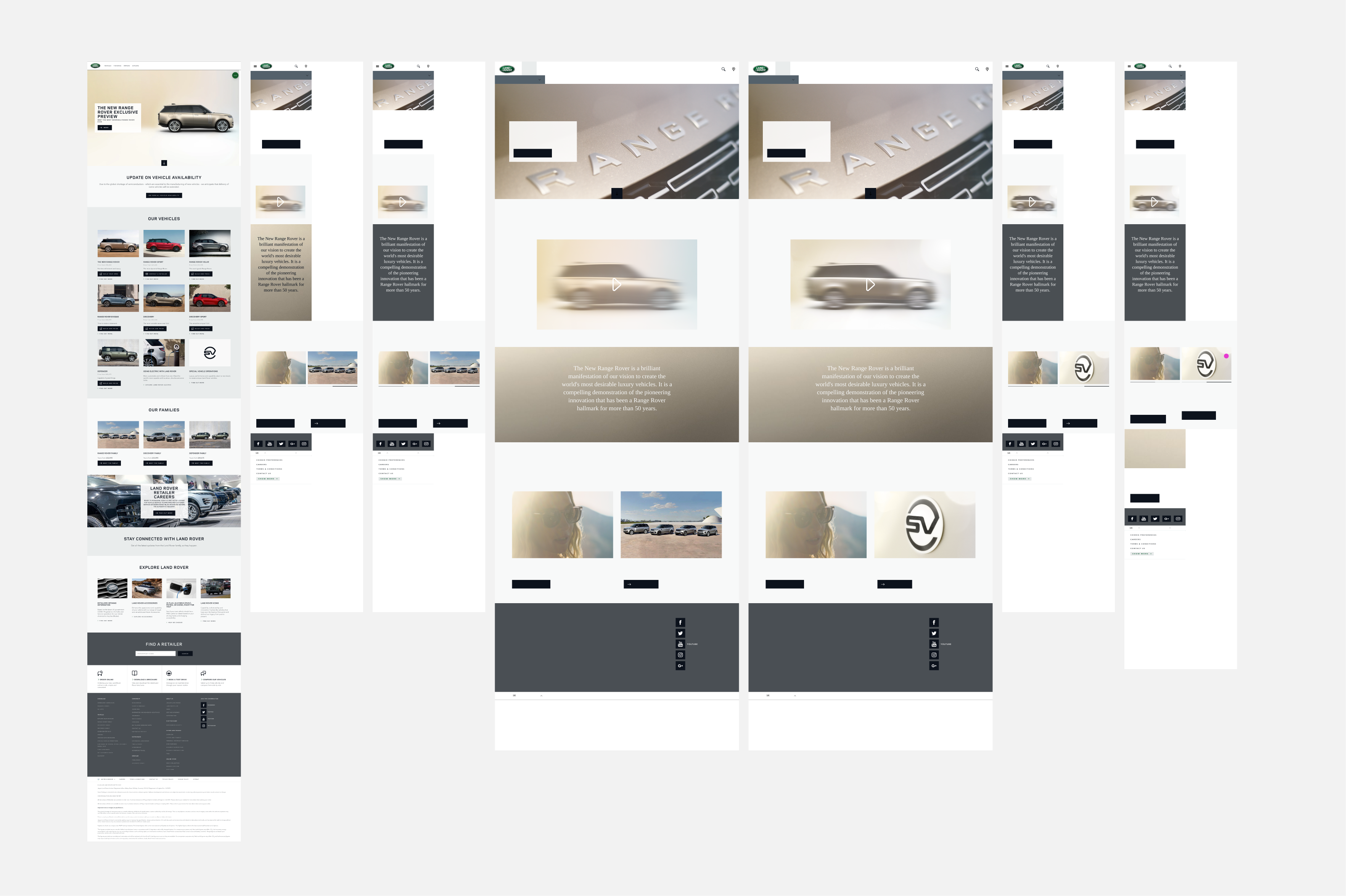
UX for Jaguar Land Rover's global vehicle pages — message-mapped IA, high-fidelity wireframes and prototypes within the Spark44 creative team.
▲ 22% 'Build Your Own'▲ 34% test drives▼ 18% bounce
FEB 2022 — NOV 2025Senior Product DesignerBarclays · Cards, Payments & Tesco Bank Acquisition→
AUG 2021 — FEB 2022UX DesignerAccenture / Jaguar Land Rover · Spark44→
2020UX/UI DesignerAbout GONG · Bookings platform, +35% bookings→
OCT 2019 — AUG 2021Freelance UX/UI DesignerIndependent Practice · incl. Metro Bank, About GONG→
04CRAFT
The craft behind the work
/ HOW I WORK
My approach to solving UX problems
01
Start with the problem, not the screen
Before sketching anything, I map the real workflow — talking to users, identifying failure modes, and understanding where the friction actually lives.
02
Frame ambiguity into structure
Complex, cross-team constraints get translated into clear service blueprints, information architecture, and design system decisions everyone can build against.
03
De-risk with prototypes, not opinions
Directions get validated early through lightweight prototypes and usability testing, so decisions are backed by evidence rather than assumption.
04
Ship, measure, iterate
Solutions roll out in stages, success is tracked against real metrics, and the design keeps evolving based on how people actually use it.
I'm particularly interested in teams working on complex financial products, AI-powered tools, or anything that needs a designer who understands the domain as deeply as the user.
Leading a zero-to-one platform transformation across a suite of mission-critical financial products — defining workflow architecture, interaction design, and end-to-end UX for complex operational environments at enterprise scale.
Client
International Investment Bank
Role
Senior UX Designer (Consultant)
Year
2025 – Present
Type
B2B · Enterprise · AI Integration
loans.internal/portfolioAI
Settled
Pending
Settled
Exception
Confidential — NDA
↑
Settlement efficiency across key workflows
↓
Payment failure rate through end-to-end redesign
↑
Exception handling throughput across operational processes
Overview
The context
Embedded within a high-performing engineering team at a major international investment bank, leading a zero-to-one transformation programme across a suite of mission-critical financial products. The role spans the full design process — from research and service blueprints through to prototyping and design system contribution.
Driving continuous discovery with operations users to surface friction points and translate ambiguous operational needs into scalable, elegant product experiences across multiple financial verticals.
Problem
What wasn't working
The platform had evolved with limited UX involvement, resulting in fragmented workflows with no single source of truth. Operations users were navigating high cognitive load across multiple systems, leading to inefficiencies in settlement, payment processing, and exception handling.
Process
How I approached it
01
Discovery & User Research
Conducted deep research with operations users to understand complex internal workflows. Shadowed day-to-day processes, ran structured interviews, and synthesised findings into prioritised opportunity areas.
02
Service Blueprinting & Ideation
Mapped end-to-end service flows across multiple financial product verticals. Led ideation workshops to identify highest-impact redesign opportunities aligned to business metrics.
03
Strategic UX Vision
Defined a multi-phase platform roadmap, established design principles for complex data-heavy interfaces, and created a prioritised backlog of UX improvements.
04
Wireframes & Prototyping
Produced mid and high-fidelity wireframes for core platform modules. Built coded React prototypes connected to the engineering team's component library for high-fidelity validation.
05
AI Integration
Identified opportunities to embed AI natively into operational workflows — designing intelligent features that reduce manual effort and unlock new capabilities for operations teams.
Design
Key design decisions
🔒
Screen designs and wireframes are strictly confidential Available to view under NDA in a private portfolio review
Leading the credit card UX workstream for Barclays' acquisition of Tesco Bank — translating existing card journeys into a white-label app experience that preserved Tesco Bank's brand identity while leveraging the Barclays design system.
Company
Barclays
Role
Senior Product Designer
Year
2024 – 2025
Type
Consumer · Cards · Acquisition
Current account£2,458.75
•••• 4471
•••• 9903
PayTransferHelp
8+
Credit card journeys designed end-to-end
10+
Usability sessions conducted with Tesco Bank customers
2
Design systems reconciled across a shared product foundation
Overview
The context
Following Barclays' acquisition of Tesco Bank, I led the credit card UX workstream end-to-end — integrating Tesco Bank's card journeys into a white-label app built on Barclays' infrastructure, while preserving the brand identity customers knew.
The work covered the full customer lifecycle, from acquisition through to card management, across a large cross-functional programme spanning both organisations.
Problem
The challenge
Platform migrations mid-relationship carry inherent retention risk. The transition had to be seamless — brand discontinuity or journey friction at this moment could erode customer trust at scale.
The core design challenge: reconciling two distinct brand identities and design systems on a shared technical foundation, where no journey could simply be lifted across without deliberate assessment.
Process
How I approached it
01
Audit & Gap Analysis
Mapped both product estates to identify where Barclays journeys could serve as a foundation and where Tesco Bank's requirements demanded distinct solutions. Led cross-org workshops to surface functional and experiential gaps.
02
Design Strategy
Established a clear approach: maximise reuse of existing Barclays journeys to reduce engineering risk, while ring-fencing areas where Tesco Bank's brand, tone, and customer expectations required purposeful divergence.
03
Design & Iteration
Designed across the full credit card journey set, iterating against usability testing with Tesco Bank customers. Collaborated with the emerging Tesco Bank Design System to ensure accurate component usage as the system developed in parallel.
04
Stakeholder Alignment
Ran structured review sessions with Tesco Bank stakeholders across flow logic, brand application, and delivery constraints — adapting design decisions as programme scope evolved.
Outcome
Where it landed
Delivered a complete, well-documented UX workstream across 8+ credit card journeys — from acquisition through to ongoing card management — with clear design rationale and decision history at every stage.
The work was handed over in a production-ready state: specs, annotations, and journey documentation structured to support seamless continuity across teams and delivery phases.
Redesigning the personal loans entry point across app and online banking — addressing the highest drop-off in the funnel through research-led design and delivering measurable conversion uplift.
Company
Barclays
Role
Senior Product Designer
Year
2023
Type
Consumer · Lending · Conversion
How much do you need?£12,500
12mo24mo36mo
Continue →
15%
Step conversion uplift in the Barclays app
13%
Step conversion uplift in online banking
5%→higher
Journey completion rate from entry point
Overview
The context
Year-on-year data showed loan application completions declining — a business-critical problem for the Everyday Money Management team. I led the UX workstream within the Loans Optimisation Programme, operating in two-week sprint cycles with each sprint targeting a specific funnel stage and producing handover-ready specs for engineering.
Discovery
Finding the problem
Funnel analysis revealed that over half of customers were abandoning before starting an application — the steepest drop-off in the entire journey. Moderated usability sessions (6 participants, Userzoom) confirmed two root causes: two near-identical entry screens created confusion at the very first touchpoint, and the Overview page front-loaded a wall of legal copy that customers associated with complexity and didn't read.
"Both screens look similar — I'm not sure what this page is telling me that the last one didn't."
— Usability Research Participant · Barclays Loan Journey Study
Process
How I solved it
01
Two parallel design tracks
Research findings shaped two distinct workstreams: a low-effort, high-impact navigation fix for immediate delivery, and a structural redesign of the Overview page to address information architecture.
02
Smart navigation — quick win
Income-verified app customers already saw their personalised rate on the Overview page — the Ecosystem page added no value for this segment. A targeted navigation change bypassed it entirely, removing friction without a rebuild.
03
Ideation and validation
Rapid lo-fi exploration through Crazy 8s and design crits, progressing to a high-fidelity prototype co-developed with a copywriter. A second round of moderated research validated the redesign — participants found it significantly clearer, with USPs that were both legible and compelling.
04
Regulatory sign-off
Designs cleared Legal & Compliance, Accessibility, Vulnerability Assessment, and Product Practice reviews. Two USPs were flagged as non-compliant and replaced with alternatives that preserved the visual intent — a routine but critical part of delivering in regulated financial services.
Designs
Before & after
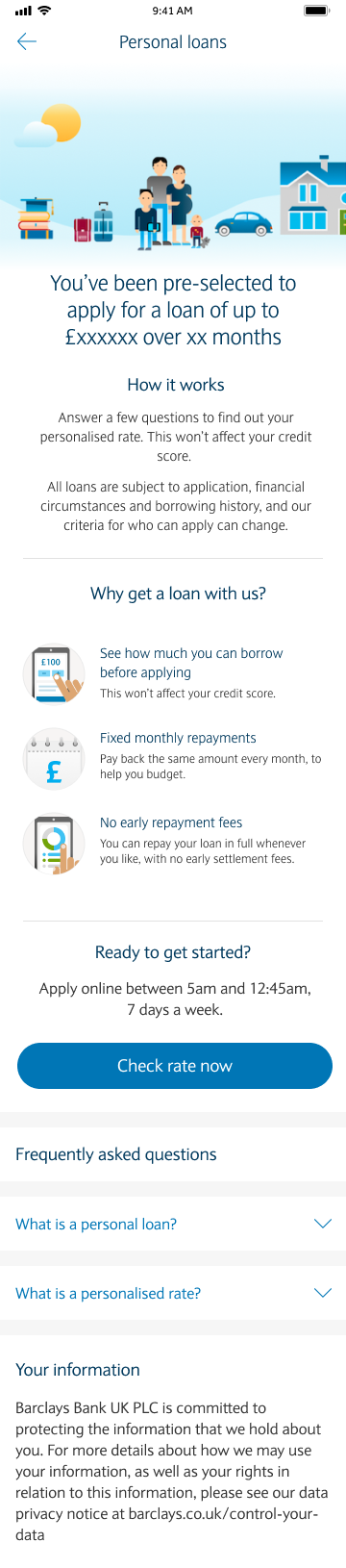
Two redundant entry screens consolidated into one — replacing front-loaded legal copy with a scannable layout that surfaces the personalised rate, product USPs, and a clear CTA.
Before
Dense copy front-loaded before the illustration. CTA buried below three blocks of legal text with no visual hierarchy.
After
Hero illustration leads. Personalised rate prominent. USPs scannable with icons. Single screen replaces two.
Outcome
The results
The navigation fix shipped first — 15% step conversion uplift in-app, 13% online, from removing a single redundant screen. The Overview redesign followed in early 2024, with further entry-point gains anticipated.
"What a brilliant team effort — already showing such powerful results."
— Unsecured Borrowing Programme Director · Barclays
Reflection
What I learned
The most impactful decision on this project was removal, not addition. Funnel data identified the drop-off; qualitative research explained it. Acting on both — fast — is what drove the result.
Led UX/UI design for the integration and optimisation of a third-party cheque-scanning SDK into the Barclays mobile app — refining the end-to-end camera capture flow to simplify a technically complex scanning process for first-time users.
Company
Barclays
Role
Product Designer
Year
2024
Type
Consumer · Mobile · SDK Integration
Align cheque within frame✓ Captured
96%
Cheque scan success rate (up from a ~30–40% baseline)
£800k
Additional revenue generated per month
↓55%
Reduction in cheques returned for poor capture
Overview
The context
Barclays' in-house cheque-scanning journey couldn't reliably capture a usable image — around 60–70% of cheques were being returned, pushing customers into branch visits or repeated failed attempts and costing the bank in processing and support overhead.
Rather than continuing to iterate an underperforming custom capture engine, the decision was made to integrate a specialist third-party cheque-scanning SDK — bringing purpose-built recognition and capture technology into the Barclays app.
Original In-House App
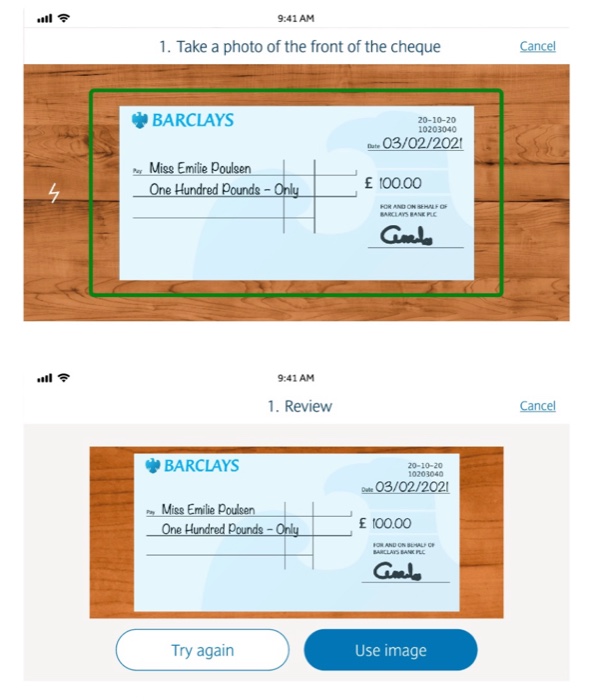
Barclays' original in-house app, shown here under ideal conditions — a flat surface, even light, clear framing.
The Ask
A simple premise on paper — point the camera, align the cheque, done. Reality was messier.
Process
Integration to optimisation
01
Failure Analysis
Investigated why the in-house journey failed so often — the feature was throwing around 2 million cheque-scanning errors a year, driven by poor framing, glare, cropping, and a lack of real-time guidance.
02
Third-Party SDK Integration
Worked with engineering to integrate a specialist cheque-scanning SDK in place of the in-house capture engine, evaluating its out-of-the-box capture and recognition performance.
03
Design Standards Alignment
The SDK's out-of-the-box UI fell short of Barclays' design standards. Reconfigured and reskinned the capture screen, guidance overlays, and error states so the third-party component looked and felt like a native Barclays product.
04
Capture Flow Simplification & Rollout
Refined the end-to-end camera capture flow — framing guidance, real-time feedback, and error recovery — to simplify a technically complex process for first-time users, then validated and rolled out.
Designs
Raw SDK to reskin
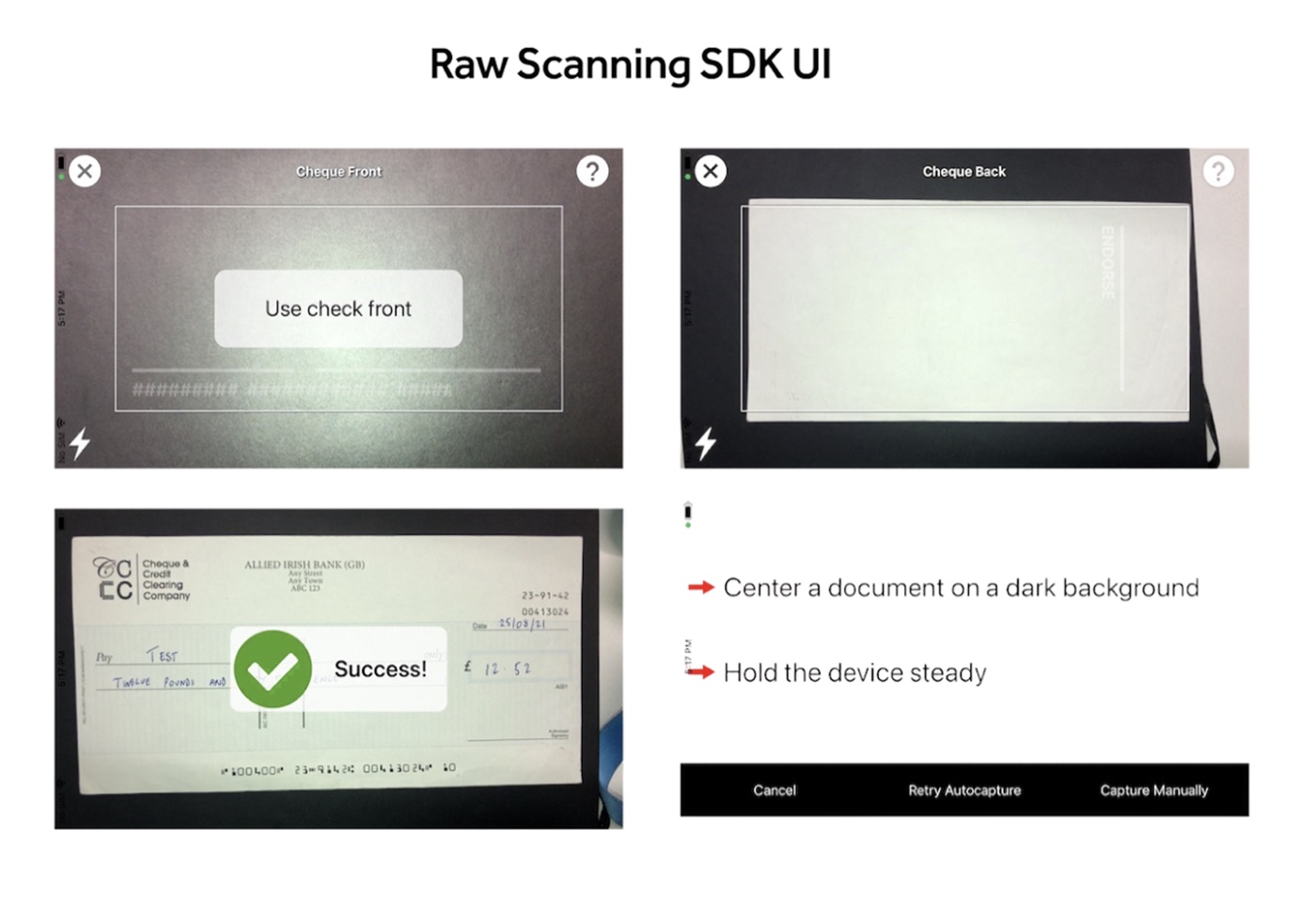
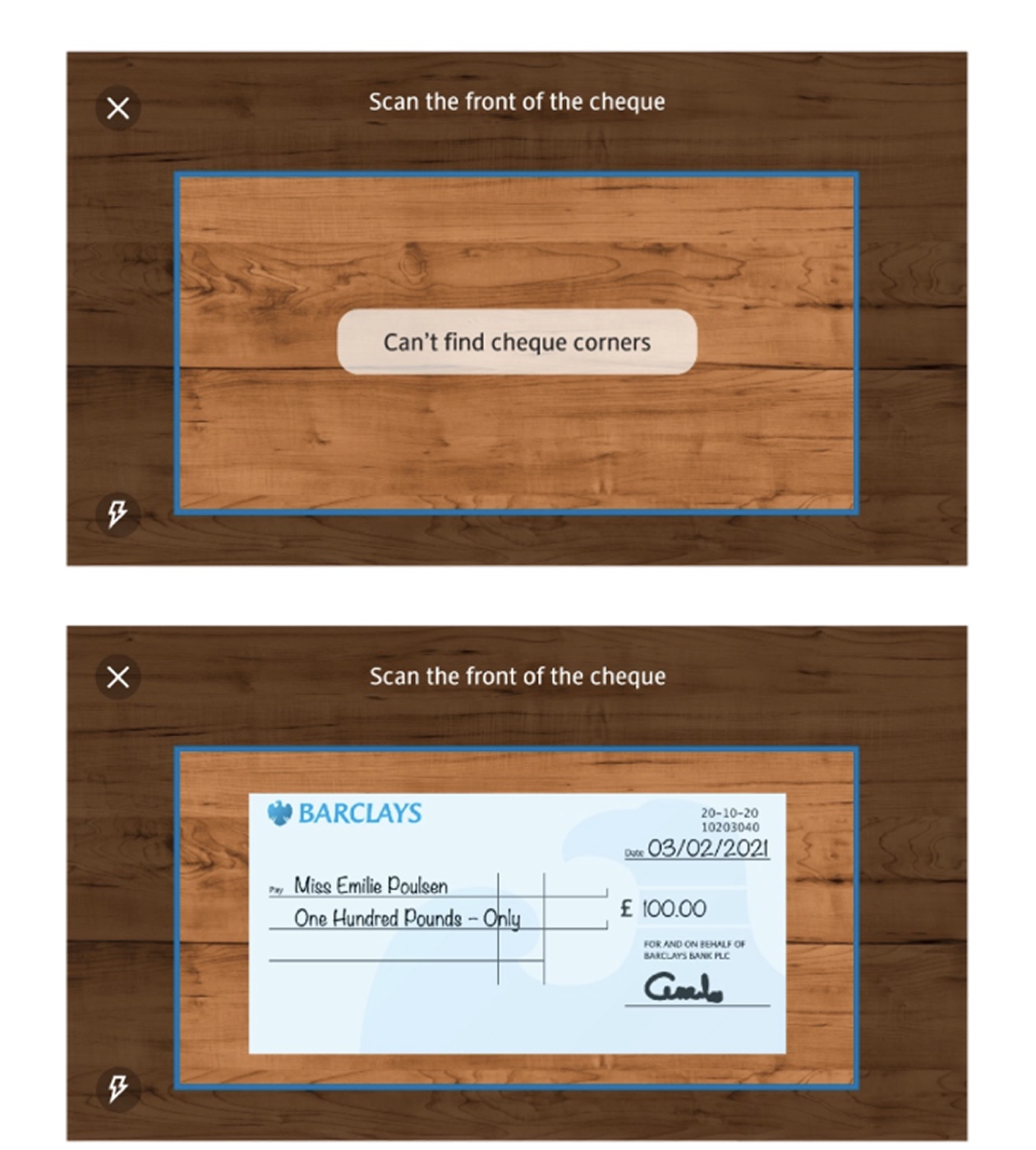
Out of the box, the third-party SDK's capture flow was capable but generic — dark backgrounds, unbranded prompts, and terse system copy like "Use check front." Reconfiguring it meant replacing every surface with Barclays' own framing guide, warm capture background, and native error and success states.
Raw SDK
Functional, but visually inconsistent with Barclays' design language — generic copy and no branded guidance.
Reskinned
Barclays' framing guide, capture background, and a friendlier "Can't find cheque corners" recovery state.
Rollout
Simplifying the surrounding flow
Beyond the capture screen itself, the entry point, in-flow guidance, and exit safeguards all needed attention to make a technically complex process feel simple for first-time users. Together with the reskinned capture flow, this removes an estimated 900,000 cheques a year from branch and post office deposits, shifting them to a self-serve journey in-app.
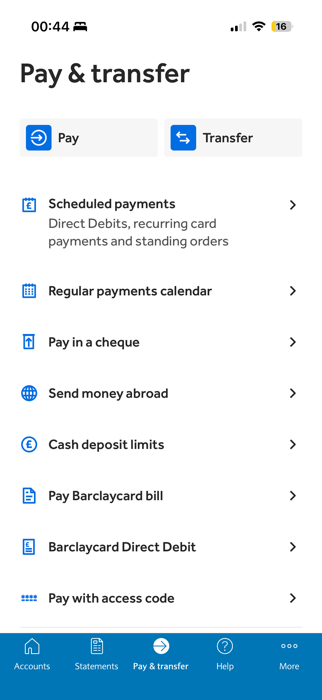
Surfaced within Pay & transfer as a clear, low-friction entry point.
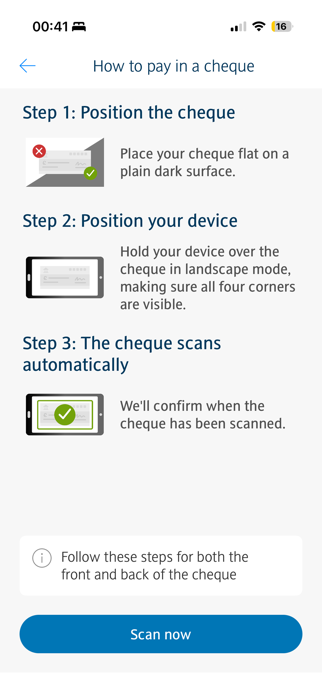
A short instructional screen sets expectations before scanning begins.
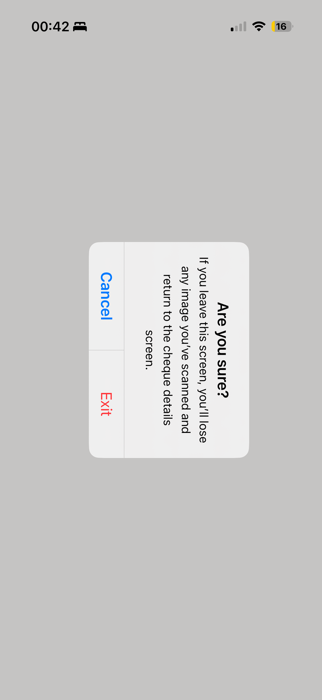
A confirmation dialog protects against accidentally losing an already-scanned image mid-flow.
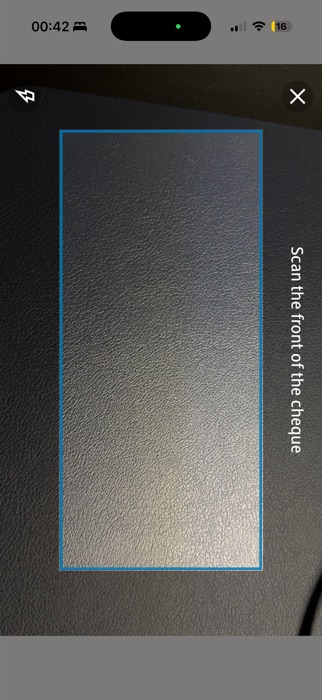
Guidance was stress-tested across real-world conditions — including dim, low-contrast surfaces — before validation and rollout.
Mobile UXCamera Capture DesignSDK IntegrationDesign SystemsFintech
UX design for Jaguar Land Rover's global vehicle nameplate pages — leading the end-to-end process from design brief through to wireframes, client presentation, and development handover across both the Jaguar and Land Rover brands.
Company
Accenture / Spark44
Role
UX Designer
Year
2021–2022
Type
Global Web · Automotive · IA
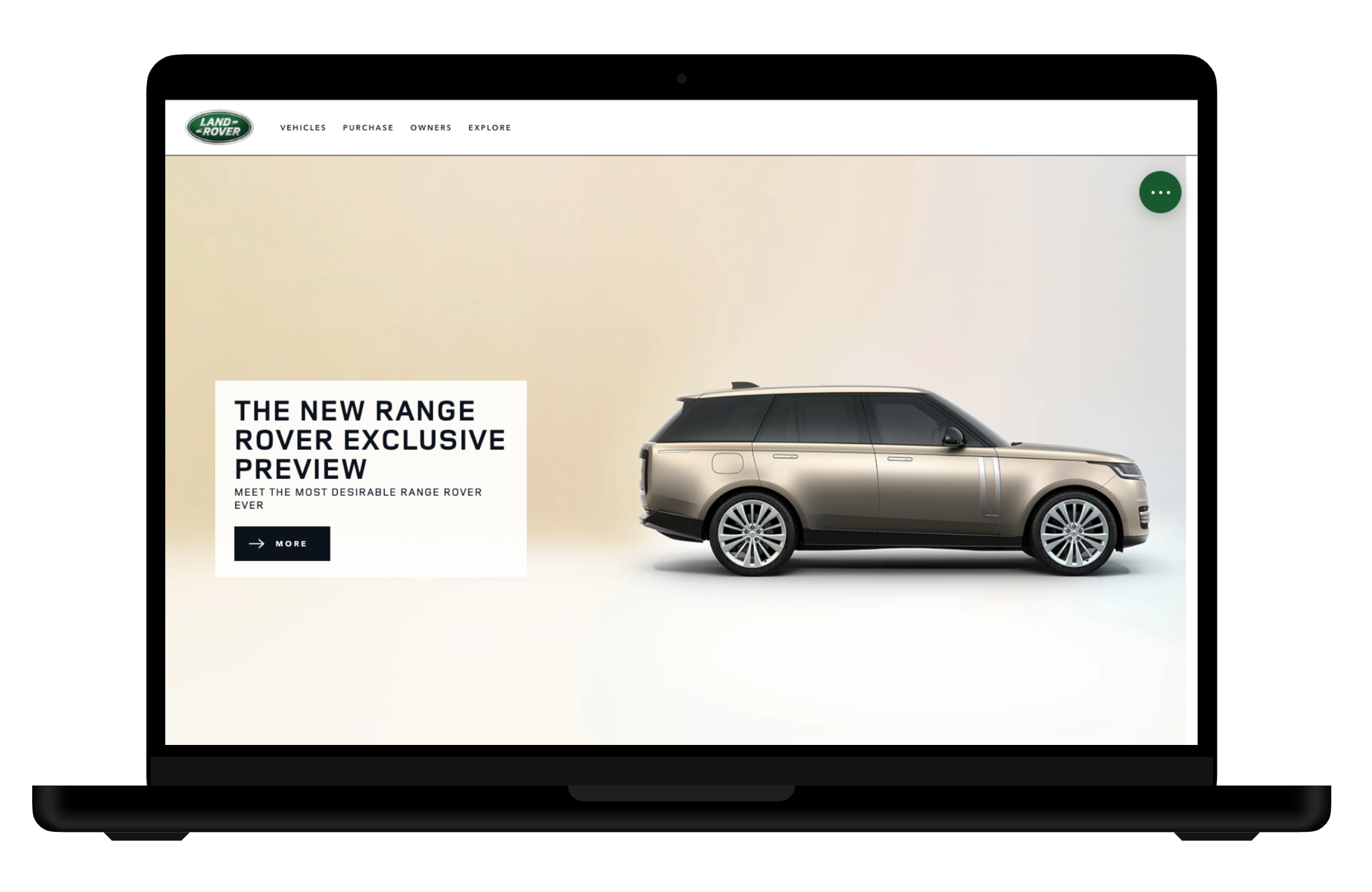
jaguarlandrover.com
RANGE ROVER
Build YoursTest Drive
+22%
'Build Your Own' CTA conversion uplift
+34%
Increase in test drive booking requests
↓18%
Bounce rate reduction across redesigned nameplates
Overview
The context
Embedded within Spark44 — Accenture Interactive's dedicated JLR agency — leading UX across vehicle nameplate pages for both Jaguar and Land Rover's global websites.
Nameplate pages are the highest-traffic destination in automotive digital marketing — the point at which a customer commits to configure, book a test drive, or leave. Getting the structure, hierarchy, and content balance right was critical to conversion.
Process
From brief to handover
01
Design Brief
Ingested client briefs covering nameplate requirements, milestone dates, and stakeholder responsibilities — translating them into a clear UX direction for each project.
02
UX Blueprint
Produced structured blueprints defining page sections, component choices, copy intent, and imagery direction. Presented to Land Rover for sign-off before any visual production began.
03
Wireframes
Translated approved blueprints into low-fidelity wireframes in Sketch using the Land Rover component library. Presented at each client milestone and iterated based on feedback.
04
Visuals, Copy & Handover
Supported the integration of approved assets and copy through to final sign-off, then packaged and handed designs over to the development team for build and launch.
Additional Work
EV entry point
Conducted a competitive analysis of how Mercedes-Benz, BMW, and Audi were positioning their EV ranges online in response to Net Zero pressure — identifying patterns and opportunities for JLR.
Designed an EV entry point for JLR landing pages that balanced the full model range with EV discoverability — positioning electric models after the primary grid to surface them without deprioritising JLR's broader lineup.